
Consumer Sentiment Tanks — Are Stock Investors Banking On False Confidence?
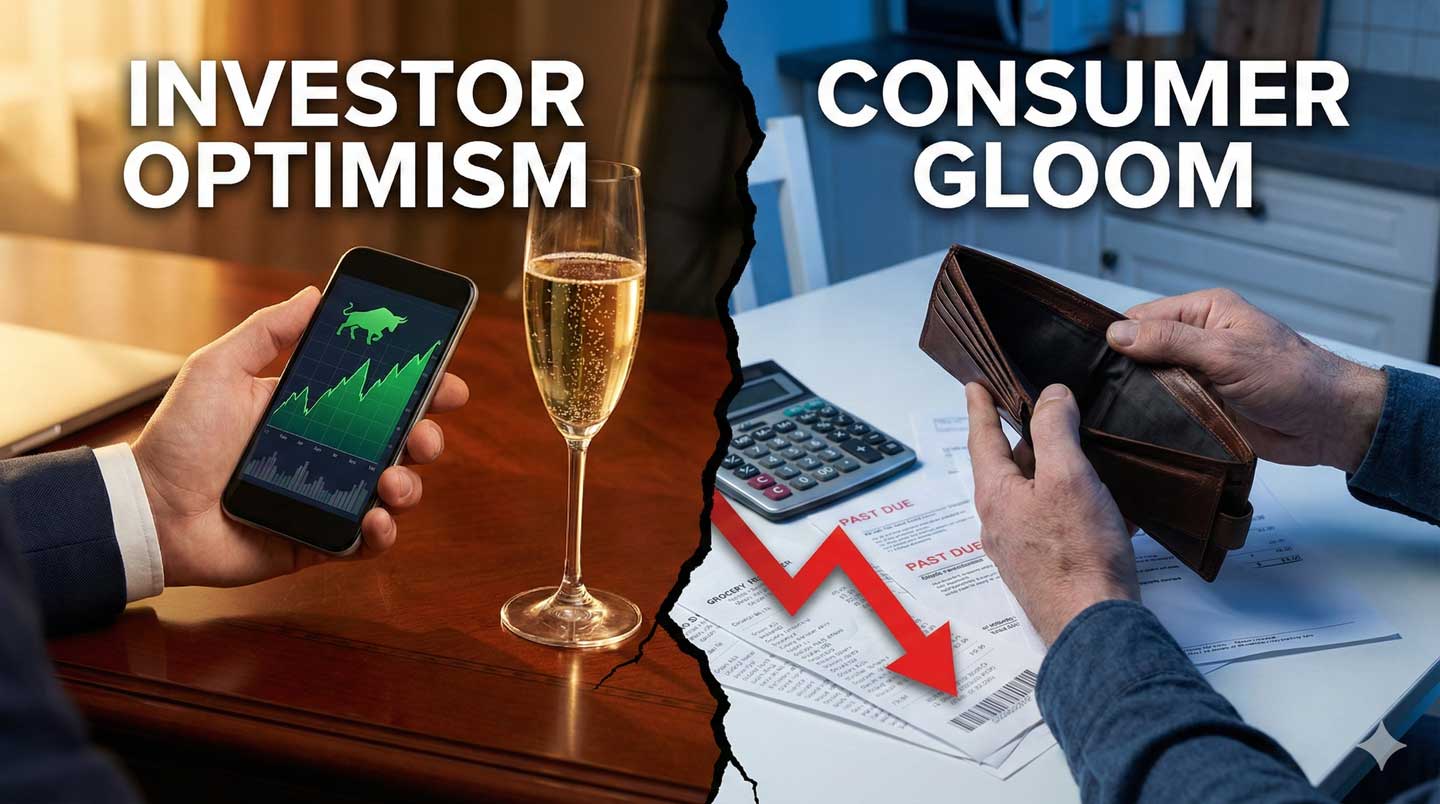
What’s really going on with investor optimism vs consumer gloom
A fresh The Wall Street Journal deep dive shows a striking divide: while many investors feel flush after recent stock-market gains, ordinary consumers aren’t feeling so hot.
The stats: sentiment among general consumers is sinking — the University of Michigan’s consumer-sentiment index recently plunged to ~51, from ~53.6 the prior month — one of the lowest readings in recent memory.
In short: investors are enjoying the rally. But the broader population? They’re feeling squeezed. That gulf matters more than you might think.
Why this split matters — two economies under one roof
Asset-holders vs wage earners
Investors who've ridden recent equity gains now feel wealthier, and that “wealth effect” may encourage them to spend or redeploy funds. Meanwhile, consumers outside the stock-owning crowd — especially those living paycheck to paycheck — see inflation, stagnant wages, and economic uncertainty hitting hard.
Economic “vibes” diverging from data
Even if macro stats look OK, public mood is souring. This mismatch — sometimes called a “vibecession” — can actually feed into weaker consumer demand, delayed spending, and higher saving or hoarding among households not feeling the stock bounce.
Market demand becomes bifurcated
When only a subset of people feel wealthy, spending and investment flows become polarized. That tends to favor risk-on, sentiment-driven trades and defensive cash/reserve moves — not broad-based economic booms.
What this could mean for markets & options flow
- Selective demand pop: Investors flush with stock-market gains may rotate into higher-beta names, cyclical plays, or jump back into risk-on assets — potentially driving some sharp single-name rallies.
- Durable under-the-hood volatility: As the general public tightens budgets, consumer-driven names (retail, autos, discretionary) may see weaker earnings, suppressed demand, and likely heavy put interest / skewed options flow as sentiment softens.
- Defensive / income-generating plays could get love: Dividend-yielding, stable-cash-flow names may draw capital as investors look for shelter from macro unease.
- Dislocation between “paper wealth” and real-world consumption: Gains on indices may not translate into stronger retail numbers, which could lead to surprises come earnings season, especially in consumer-sensitive sectors.
If you watch these patterns on Unusual Whales — via GEX, open interest, and historical options flow — you might already see early signs of this bifurcation.
Hot tickers to track on Unusual Whales
- Growth / risk-on names — look for elevated call-buying or gamma exposure as investors chase upside.
- Consumer-cyclical / retail names — possibility of put-heavy flow if demand softens.
- Dividend-payers / defensives — may attract stability-seeking money; watch for increasing open interest or skew shifts.
- Index ETFs — as broad wealth flows shift, these could see rotation in or out depending on macro sentiment.
If you monitor any of these tickers on Unusual Whales — especially using flow and GEX tools — you could spot where sentiment is translating into real money moves.
Do you want to see how to make more plays? Do you want to find gains yourself?
Unusual Whales helps you find market opportunities through our market tide, historical options flow, GEX, and much, much more.
Create a free Unusual Whales account to start conquering the market.
The big picture: sentiment divergence may sow market instability
When only a slice of the population feels financially secure — and many others don’t — equity markets risk becoming unmoored from the real economy.
That dynamic can lead to unstable rallies, mispriced risk, and sudden corrections, especially if consumer-driven sectors begin to underperform.